Church Blog
News, Updates, Thoughts
The latest news, updates, and thoughts from Walbury Beacon Benefice.

Whitsun
When I first started teaching – in a huge Church of England school in North London – Ascension Day was greatly looked forward to: it was a half-day’s holiday. At 9:0’clock we all traipsed off to the church, forming an enormous crocodile and holding up the traffic; then back at school we attempted to find something useful to do for a couple of hours before welcome release at midday. I found getting the children to illustrate the Ascension – and learning to spell it – was a good activity, always producing plenty of rather gormless disciples scratching their heads as a pair of feet disappeared skywards. Coming on a Thursday, it gets a bit overlooked these days – it’s important though: no Ascension – no Pentecost.
Which brings me on to:-
Whitsun, as we then knew it, was even better than Ascension – in those days it heralded a Bank Holiday and half-term. Why “WHITsun”? Almost certainly “hwittesunnandæg” – White Sunday – although there is some uncertainty as to the significance of the “white”: it was possibly because the priests wore white, or because it was a popular day for Baptisms, when the candidates would wear white (think of traditional Christening robes for babies) or maybe because the young women would find something white to wear to church. It marked the start of a holiday period in this country even in mediæval times – a double reason to celebrate.
So that’s our original Anglo-Saxon; the name Pentecost (from the Greek for 50) reminds us that the events we read about at the beginning of the second chapter of Acts, took place on the Jewish festival “Shavuot” (the Feast of Weeks), exactly 50 days after “Pesach” (Passover) which is why the crowds speaking so many different languages had gathered in Jerusalem. It’s easy to lose sight of how this period in our Christian year is so deeply rooted in the Judaism of Jesus’ own faith.
And with all this Pentecostal excitement beforehand, we often almost forget about Trinity Sunday. Or perhaps it’s just too difficult to get our heads around the notion of a triune deity, so we let the day pass without much notice, then slide quietly into the months of green Sundays after Trinity. The Church Fathers at Nicæa thought they had cracked it – or at least reached agreement, in the Creed, on a form of words to wrap around the concept – but attempting the definition contributed to a lasting split between Eastern and Western Christianity, and it has continued to intrigue theologians (from the 4th Century Athanasius . . to our very own Patrick) who have all wrestled for hundreds of years with trying to comprehend and articulate the belief. And the title to Patrick’s book – I think – is actually a neat definition of the impossibility of such an attempt.
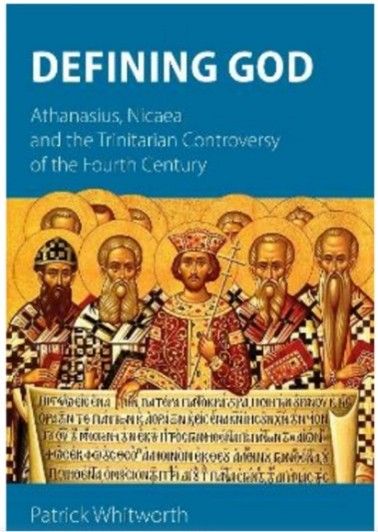
“3-in-1 and 1-in-3” – it trips off the tongue and trips up the brain.
I think it’s really good for us mortals to contemplate the indescribable from time to time – it cuts us right down to size!
Jenny
Sadly – I shall miss out on this year’s Walbury Beacon Pentecost celebration – I have Godmotherly duties elsewhere at a White-Sunday baptism!
- Jenny Veasey
- 01488 657911

Finding God with a smile
Our Humour and playfulness in church are not about making faith less serious. They are often what make it properly serious. Without them, church can drift into something tightly controlled, where we observe faith from a distance rather than actually entering into it. With them, faith becomes something lived—shared in the body, not just held in the head.
Humour has a disarming effect. It loosens our need to perform or to get everything right. It creates space where people can simply be present before God as they are. That matters, because so much of the gospel is about receiving rather than achieving, trusting rather than controlling.
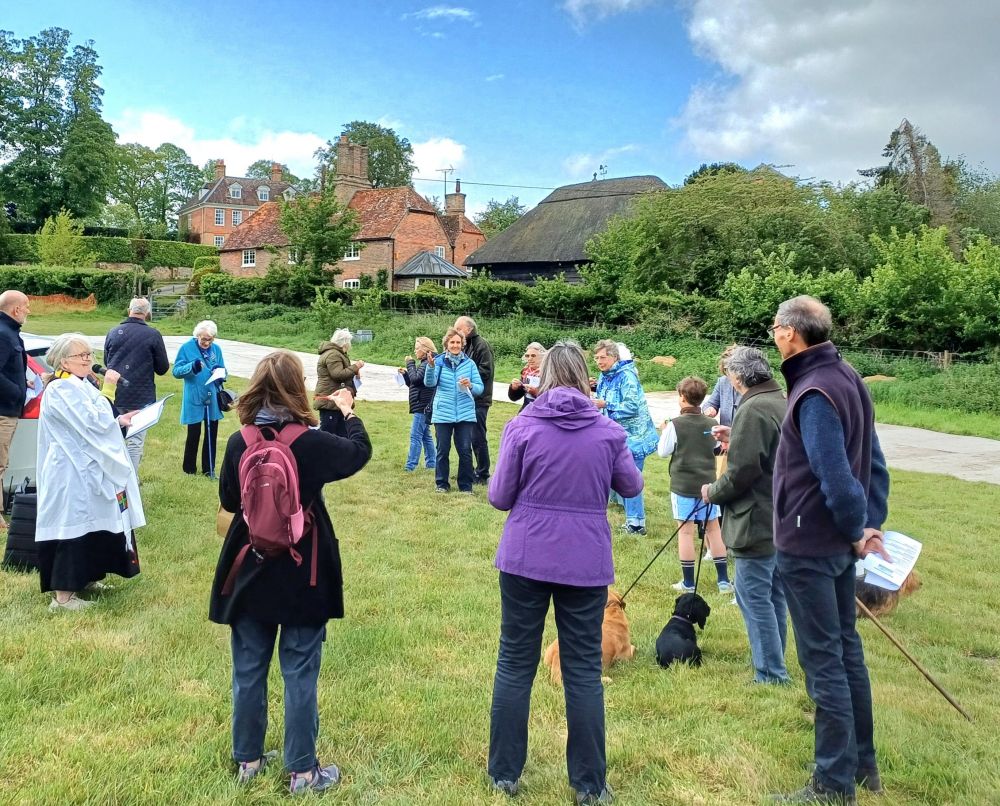
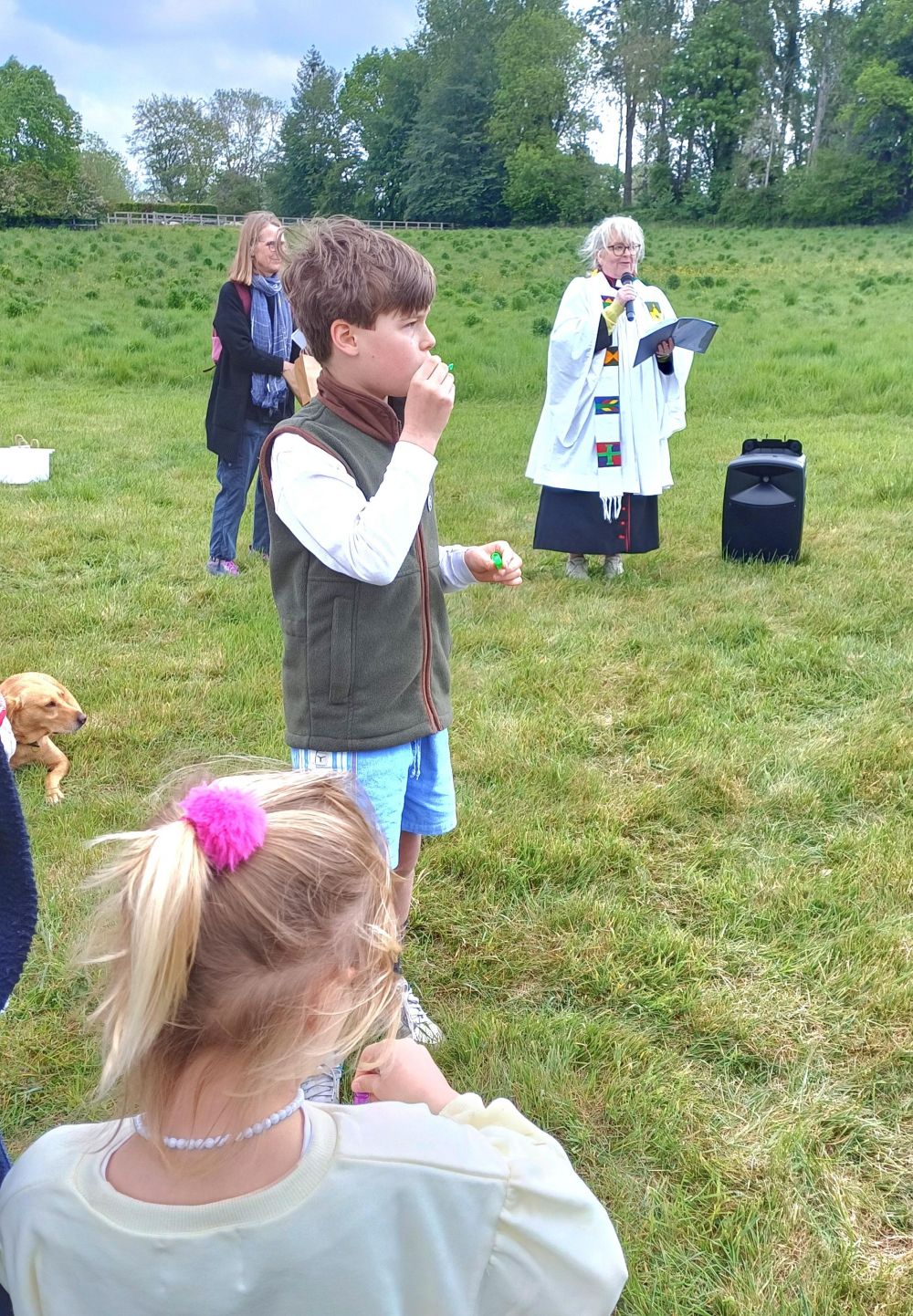
That was very visible last Sunday at the Rogation service, when I invited adults to join the children in blowing bubbles. On the surface it was simple—even a little absurd. Grown adults, standing in a field, dipping wands into soap and sending bubbles drifting into the air. But something important happened in that moment. People laughed, but not at faith. They laughed within it.
Barriers dropped. Self-consciousness softened. And suddenly, prayer was not just spoken words but shared experience. The bubbles themselves became a kind of living parable: fragile, beautiful, unpredictable, impossible to hold. They caught the light for a moment and then disappeared. In their own way, they reflected something of the openness of Rogation—prayer for growth, for land, for life that is always received rather than controlled. Even the faint echo of a mustard seed is there: something small, easily dismissed, yet carrying meaning far beyond itself.
This is why playfulness matters. It allows faith to be embodied, not just explained. It reminds us that the Kingdom of God is often recognised in small, easily overlooked moments—things that do not announce themselves loudly but are discovered in attention and wonder.
That same truth is carried into our upcoming pet services on 28th June at 9.45am in Inkpen and 5th July at 9.45am in Kintbury. Animals bring their own kind of holy unpredictability. Yet rather than disrupting worship, they often deepen it. They remind us that life is not neat, and that God is not confined to what we can manage or control.
There is joy in that unpredictability. Animals draw out affection and laughter without calculation. They remind us of loyalty, dependence, and simple companionship. In a pet service, those qualities are not distractions from prayer—they become part of it. They help us recognise that creation itself is held within God’s care.
Bringing pets into church also gently expands our understanding of worship. It says that faith is not removed from ordinary life but includes it. That what we often separate as “sacred” and “everyday” is more closely woven together than we think.
So whether it is bubbles drifting across a field or a dog settling unexpectedly in a pew, these moments are not interruptions to faith. They are invitations into it. They remind us that God meets us not only in what is carefully controlled, but also in what is unplanned, playful, and alive.
- Revd. Annette Shannon
- 01488 646385
Spring is here
Dear Friends,
We are at the beginning of wedding and baptism season — one of the loveliest times of year in the life of the church. As the countryside bursts into colour and the days grow longer, we will see couples standing before God to make their vows, and families bringing children — and sometimes adults — for baptism. These are deeply joyful occasions. They are not simply private milestones, but moments when we, as a church family, promise prayer, welcome, and support. They speak of love, commitment, belonging, and new beginnings.
Alongside these celebrations come some important moments in our shared church life. In April and May we hold our APCMs — the Annual Parochial Church Meetings. The title may sound rather grand (or slightly daunting!), but they are simply our yearly opportunity to reflect and look ahead together.
At the APCM we:
Give thanks for the year past
Review finances and ministry
Elect churchwardens and PCC members
Consider where God might be leading us next
It’s about gratitude, vision, and shared responsibility. The church belongs to all of us, and this is one of the ways we shape its future together. I do hope you’ll come, take part and support the volunteers who keep the churches active.
In May we also look forward to our Rogation service — an informal outdoor benefice. This year we are gathering in the field opposite Inkpen Church. Rogation is when we pray for the land, farmers, crops, and all who produce our food. There will be activity packs for children, and plenty of space to enjoy being together outdoors. If you’re feeling energetic, you might even consider walking from your own parish to join us — a small pilgrimage across the countryside we’re praying for.
Then comes Ascension Day, forty days after Easter, marking Christ’s return to the Father — a quiet but triumphant reminder that the risen Christ reigns and prays for us.
After that we celebrate Pentecost, the Church’s birthday. This year we will gather in the car park at Combe Gibbet, with that glorious sweeping view across the valley. It’s a fitting place to remember the rushing wind and fire of the Holy Spirit — when ordinary disciples were filled with courage and sent out in hope. Do come and share in that joyful, open-air celebration.
Finally, Trinity Sunday invites us to reflect on the mystery at the heart of our faith: one God, Father, Son, and Holy Spirit — a relationship of love into which we are drawn.
April and May are not just busy months; they are full of life and promise. Worship indoors and out, walking fields, gathering on hilltops, celebrating new beginnings — it’s a beautiful picture of a living church.
So do join in where you can. Come to pray, to celebrate, to walk, to sing, to belong.
Spring is here — and God is very much at work among us.
With every blessing,
Revd Annette
- Revd. Annette Shannon
- 01488 646385

New Life
It is a wonderful time of year as blossom, leaves, flowers, growth and birdsong proliferate, and we are fortunate in our hemisphere that Spring coincides with Easter which itself proclaims New Life through the Resurrection in which the old order of “sin and death” is overcome. It is also the season when the Church celebrates Baptism: the entrance of people into the family of the Church through their faith in Jesus. So, churches from earliest times ran courses of instruction for those to be Baptised. Indeed, we still have the text of such a course run by Cyril of Jerusalem in c350 AD for the catechumens (those to be baptised) in his day in Jerusalem. The course then comprised teaching on the Trinity, Incarnation, Baptism, holiness of life and entailed twenty-two lectures! I have a copy!
So, it was especially wonderful last week in Eastertide that we had a Service of Confirmation and Renewal of Baptismal vows at St Mary’s Kintbury with candidates from several churches. Many had finished a course of “catechetical talks” called the Alpha Course, a modern way of explaining the same truths as Cyril did all those years ago! Congratulations to them, and especially to the young people, as they set out on their journey of faith and the life-style they embraced in that service of celebration led by Bishop Mary. We, the community of this Benefice, will be supporting you with our prayers, interest and love and look forward to seeing you from time to time.
In the meantime, let’s enjoy the warm sunshine, the burgeoning Spring growth and everything that goes with it. We are in the fifty days from Passover (Easter) to Pentecost when Jesus appeared with many proofs of his Resurrection to the disciples preparing them for the Mission ahead and giving them the Holy Spirit to enable this task. May it be a be a special time for you all as we wait for Pentecost
Patrick Whitworth
- Patrick Whitworth
Eastertide
Dear friends,
During this Eastertide, as we walk in the light of the resurrection, I want to share a true story that has stayed —one that echoes, in a quiet but powerful way, the journey on the road to Emmaus.
Dave worked alongside someone who was quite certain there was no God. Faith, to him, was little more than a relic—something to be explained away, even gently mocked. Life was practical, measurable, and contained within what could be seen.
One day, Dave’s colleague went to visit his father, who was seriously ill in hospital. As he walked through the corridors, preoccupied and heavy-hearted, he passed the multi-faith room. For reasons he couldn’t explain, he felt drawn to go in.
Inside, he noticed a small Christian prayer space. Somewhat awkwardly, unsure of what he was even doing, he found himself speaking—asking, simply, for his father. He did not expect anything in return. No voice, no sign, no sudden certainty. Just words spoken into what he assumed was silence.
After spending time with his father, who later passed away, he made his way out of the hospital. On the way, he stopped at a shop and was delayed for a few moments. Then, walking down the corridor toward the exit, he saw a woman in a dog collar approaching.
As she passed him, that same unexplainable pull came over him again. This time, he turned and called out, “I’ve just spoken to him.”
The woman stopped, turned back, and said simply, “He knows. And he was listening.”
The moment shook him. Not because it answered every question, but because it opened one he could no longer dismiss.
In this season, we remember how the risen Christ walked alongside two disciples on the road to Emmaus, and yet they did not recognise him at first. It was only later, in the breaking of bread, that their eyes were opened—and they realised he had been with them all along.
So often, God meets us in ways we do not expect—in passing moments, in quiet urgings, in words that seem meant just for us. Not always with grand signs, but with a presence that gently insists.
Perhaps faith does not begin with certainty, but with a moment of honesty—a simple reaching out, even when we are unsure anyone is there.
And perhaps, like those disciples, or like Dave’s colleague, we come to see, in hindsight, that we were never walking alone.
May this Eastertide open our eyes to the quiet nearness of Christ among us.
With every blessing,
Rev Annette
- Revd. Annette Shannon
- 01488 646385
Spring still has the capacity to surprise me.
Even after all these years, Spring still has the capacity to surprise me.
In a shady spot of my garden, I found a clump of violets. I’ve never planted violets, and would certainly not have put them right by the path, where Topaz (the cocker spaniel) plays oh-so-energetically with her ball. But there they are, sprung out from dark to light, quietly and unexpectedly blooming. And, apparently, flourishing – despite rather poor soil and such potentially overwhelming odds.
I am always excited, and surprised, by these weeks between the Resurrection and the Ascension. Who can tell where Jesus may pop up next? In the garden, out on a walk, on the shore, on a mountain top, inside a locked room? The disciples must have been breathless, bewildered, and in a state of constant expectation after their dreadful few days over the Passover.
Maybe they needed that period of extremes, of uncertainty, of unsettlement, to prepare them for the next stage in their roller-coaster ride with Jesus – the equally extraordinary events of Pentecost.
But that is weeks away – for now, let’s just live in the present, with all its delights, surprises, sorrows – and reconnect with the living Lord.
Jenny
- Jenny Veasey
- 01488 657911
A Pastoral Word on Mental Health and Hope
A couple of weeks ago, I attended a wonderful comedy evening in Newbury, ‘Laugh Out Loud for Mental Health’, in support of the Charlie Waller Trust. It was a joyful evening, full of laughter—but beneath the humour was a serious message: mental health matters, and we all have a part to play in supporting those who struggle. I was especially grateful to be watching the show with my son Nick, a surgeon living in Singapore.
The Charlie Waller Trust raises awareness, provides support, and educates communities about anxiety, depression, and suicide prevention. From a Christian perspective, their work reflects our call to love our neighbour as ourselves (Mark 12:31). Psalm 34:18 reminds us, “The Lord is close to the broken hearted and saves those who are crushed in spirit.”
Hearing Nick talk about Singapore reminded me how differently mental health has been understood. Until recently, attempting suicide there was a criminal offence, punishable by fines or imprisonment. Only in 2020 was it decriminalised, allowing people to seek help without fear. In the UK, the Suicide Act 1961 ended criminal penalties for suicide, marking a shift from punishment to care and compassion—a stance the Church has long supported.
Both countries now have organisations supporting mental health. Here in the UK, alongside smaller charities like the Charlie Waller Trust, larger organisations such as Mind, Samaritans, Rethink Mental Illness, CALM, and PAPYRUS offer practical help, therapy, and education, reaching individuals and families alike.
Mental health struggles affect families deeply. Parents, spouses, and siblings often carry anxiety, guilt, or helplessness alongside their loved ones. The Church is called to offer support, prayer, and reassurance, helping families as well as those directly affected.
As we move through April, with spring around us and Easter approaching, it is a season of renewal and hope. Just as the earth awakens—flowers blooming, trees budding, longer, brighter days—so hope and healing can grow, even after long periods of darkness.
A couple of years ago, our church hosted an evening on faith and mental health, which was encouraging for all who came. We are exploring running another similar evening soon, and I hope many will join us—to learn, ask questions, or offer support.
Practical ways we can all help include:
· Being present: listening without judgment, to the person struggling and their family.
· Checking in: a phone call, card, or visit can lift a heavy burden.
· Supporting local and national charities through donations or volunteering.
· Encouraging open conversation about mental health in church and community life.
Laughter can be healing, but it is only part of a wider effort to reduce stigma, create safe spaces, and encourage honest conversation. I encourage us all to reflect Christ’s presence in dark places, offering hope, compassion, and practical care to those in crisis and their families.
With every blessing,
Annette
- Revd. Annette Shannon
- 01488 646385
Walbury Beacon News
My first curacy back in 197 -9 was in at St Micheal-le-Belfry, York; a city centre church just across the road from York Minster and, now, also a statue of the Emperor Constantine who was proclaimed Emperor their aged 36 in 306AD by the Praetorian Guard. York was a wonderful place to live and work. It was also known for its medieval Mystery Plays which were so much part of medieval life and which largely disappeared in the Reformation, as a less visual and more word-centred form of the faith was embraced. But to some extent these Mystery Plays have been revived and elsewhere in Europe they have flourished as in Oberammergau, villages in Greece, Spain and France. Although they vary in scope- some like the York and Wakefield plays cover scenes from Creation, through The Fall to the Final Judgement, most will have scenes taken from the final week of Christ’s life: his Crucifixion and Resurrection. One can imagine people being deeply affected by seeing these events re-enacted, and especially by people they knew. (Nikos Kazantzakis wrote a famous book, Christ Recrucified, about such a village play in Greece)
We are now on the brink of Holy Week and what a week it is, if we can take the time to re-live it again, if not by appreciating a Mystery Play at least by hearing the story again both in our Services through the week and on Easter Day. The Gospel writers spend from a third to a half of their accounts on this final week of Jesus’ life, not least St John, the Beloved Disciple. His account begins in John Chapter 12 and concludes with the Resurrection appearances in John 20 and 21. In these chapters we have Jesus’ washing of the disciples’ feet, the Last Supper (although not specifically mentioned by John), the Upper Room teaching of the Jesus to the Disciples, Gethsemane, the arrest, trials, crucifixion, burial and Resurrection. Mark begins his account in Chapter 11 and will take five Chapters to record similar events and includes different teaching by Jesus in the Temple courts prior to his arrest.
How best to let these remarkable days sink into our lives and make a difference? Why not take one of the Gospels and read its passion narrative through slowly this week, or listen to some music which reflects the meaning of what we read like Handel’s Messiah or J.S. Bach’s St Matthews or St John’s Passion. Above all take the time; what could be more important and accompany your reflection with a prayer of response. I conclude with one of my favourite prayers from St Richard of Chichester,
Thanks be to thee, O Lord Jesus Christ, for all the benefits which thou hast given us, for all the pains and insults which thou hast borne for us. O most merciful Redeemer, Friend and Brother, may we know thee more nearly, follow thee more nearly, now and for evermore. Amen
Patrick Whitworth
- Patrick Whitworth
Walking the Easter Story (with muddy boots and hopeful hearts)
One of the things I love about Easter is that it refuses to stay tidy. Just as we think winter has had the final say, Easter arrives — along with muddy paths, lighter evenings, lambs in the fields, and the first brave shoots in the garden. New life has a habit of turning up when we least expect it.
I’m always reminded of this when I’m convinced something in my own garden hasn’t survived the winter, only to spot green pushing through what looked like lifeless soil. Easter faith says that this is not just gardening optimism — it’s theology. Christians believe that God is in the business of renewal, not only in souls, but in the whole of creation.
The Easter story begins on Palm Sunday, when Jesus rides into Jerusalem on a donkey. It’s joyful, hopeful, and slightly chaotic — much like life itself. In Inkpen, we hope to welcome donkeys again this year, reminding us that God often arrives not in power and polish, but in humility and gentleness. As one hymn puts it, “Ride on, ride on in majesty… meekly on to death He goes.”
But the cheering doesn’t last. Good Friday takes us to harder ground. In Kintbury, we will mark the day with a short Walk of Witness, carrying a cross made from our old Christmas tree. I find that deeply moving: the wood that once held lights and celebration now shaped into a cross. The child born at Christmas is the same Christ who walks the way of suffering. Or as the hymn says, “Love so amazing, so divine, demands my soul, my life, my all.”
Later that day, there will be a meditative Good Friday service in Inkpen — quiet, spacious, and honest.
And then comes Easter morning.
Across the benefice, churches will celebrate the resurrection — the astonishing claim that death does not have the final word. In Kintbury, after the 9.45am service, there will be an Easter egg hunt, because Easter joy is not meant to be sensible or restrained. As another hymn reminds us, “Thine be the glory, risen, conquering Son.”
Easter does not deny suffering; it walks straight through it. It says that despair is real — but not ultimate. That endings are not the end. That new life is possible.
Whether you come every week, haven’t been for years, or are simply curious, you are warmly invited to walk this Easter journey with us — and perhaps to ask what it might mean to live as if hope were still possible, trusting that new life can emerge even from places we had quietly written off.
With my prayers and every good wish,
Revd Annette
- Revd. Annette Shannon
- 01488 646385
“Dancing to the Heartbeat of God”
If you keep an eye on the various attachments and bits and pieces which Tamara circulates each week with the readings, you may well have noticed that – very much at the last minute – it was agreed to run a short series of Lent discussions this year. It was rather a scramble to select something suitable, accessible, easily available and non-sequential, so that people can dip in and out if necessary. We are finding that this year’s Archbishop’s Lent book, which focuses on – and celebrates – the worldwide Anglican Communion, is giving rise to some interesting discussions as we read a variety of contributions from Christians in all places and circumstances around the world. We are, from sheer practicality, having to home in on just a few of these, choosing chapters which, for various reasons – eg: subject matter, personal interest, life experience – resonate with individual members of the group, generating varied and thought-provoking conversations.
One chapter was contributed by the Archbishop of Cape Town who asked a wide range of groups and individuals the apparently simple question: “Why do people still come to church here?” Two of our group drew attention to this section – one having lived for many years in Africa, and so responding out of personal experience, the other bringing it right home to wondering about its application here in Walbury Beacon in leafy West Berkshire – Why do people come to church here? “Getting back on track” & “Community and a sense of belonging” were suggested, and one person described feeling a sudden, strong sensation of kinship within one of our recent standard Sunday morning congregations.
Another discussion, about making judgements on situations and systems you have not experienced for yourself, led to reminiscences about time spent living and working in Hungary during the Soviet regime, the secrecy and the constant need for watchfulness – reinforced by frequent and never-to be-spoken-of “disappearances.” We also considered the difference in outlook and attitude between the “wealthy West” and people and communities who possess, effectively, nothing – yet for whom Christian hope, hospitality and generosity are tangible and daily realities.
One chapter is written by a Canadian prelate, who escapes when he can to his “old friend” – a solitary silver pine which he calls the “Vigil Tree” as it “keeps watch over the sanctuary of the forest”. We thought about experiencing faith in the beauties of the outdoors, in our lovely part of the country, and on mountain tops, holy places in the Bible – while recognising that it is present wherever we may happen to be. One person shared a photo, taken on a dog walk the day before, of a cloud formation which looked like a dove and which spoke clearly to her – “God is here.”
I wasn’t planning a Lent group for this year – but I’m so grateful to the people who requested one – and who have been sharing their thoughts and responses. One of the chapters is called “Waiting in Hope” – this reminded one of the group of this wonderful quotation which she shared with us, and I want to share with all of you:
“ Hope is the ability to hear the music of your future: Faith is the ability to dance to it today.”
I found myself also interested in what the book, although “written” by and about other people, might tell us about Dame Sarah, Archbishop Sarah, herself. She has taken a verse from Mark’s Gospel ‘Go into all the world and proclaim the gospel to the whole of creation.’ (Mark 16:15) as the header for her Foreword, and the starting point for the book; she reverts to it in the Afterword, describing it as a “rousing, but daunting” command and one which is likely to look different in practice for all Christians in their own specific context.
“This book,” she writes, “with its stories from right across the Anglican Communion, has given me great encouragement.”
It feels encouraging to me, also, that our new Archbishop has chosen to let others tell the story – each according to circumstance and situation – for this, her first official publication.
Jenny
- Jenny Veasey
- 01488 657911